The rapid evolution of Generative AI (GenAI) is no longer a futuristic concept but a present
reality reshaping global classrooms. For countries in the Global South, including Indonesia, AI
presents a dual-faced phenomenon: it offers an opportunity to provide high-quality, equitable
education, yet it threatens to widen the existing achievement, digital, and socio-economic
divide.
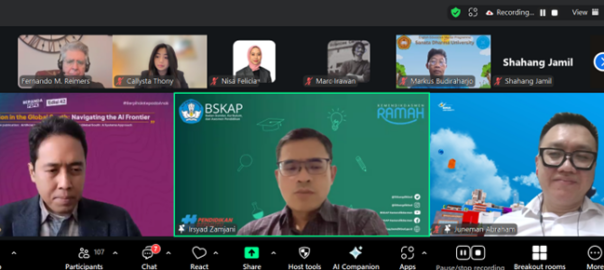
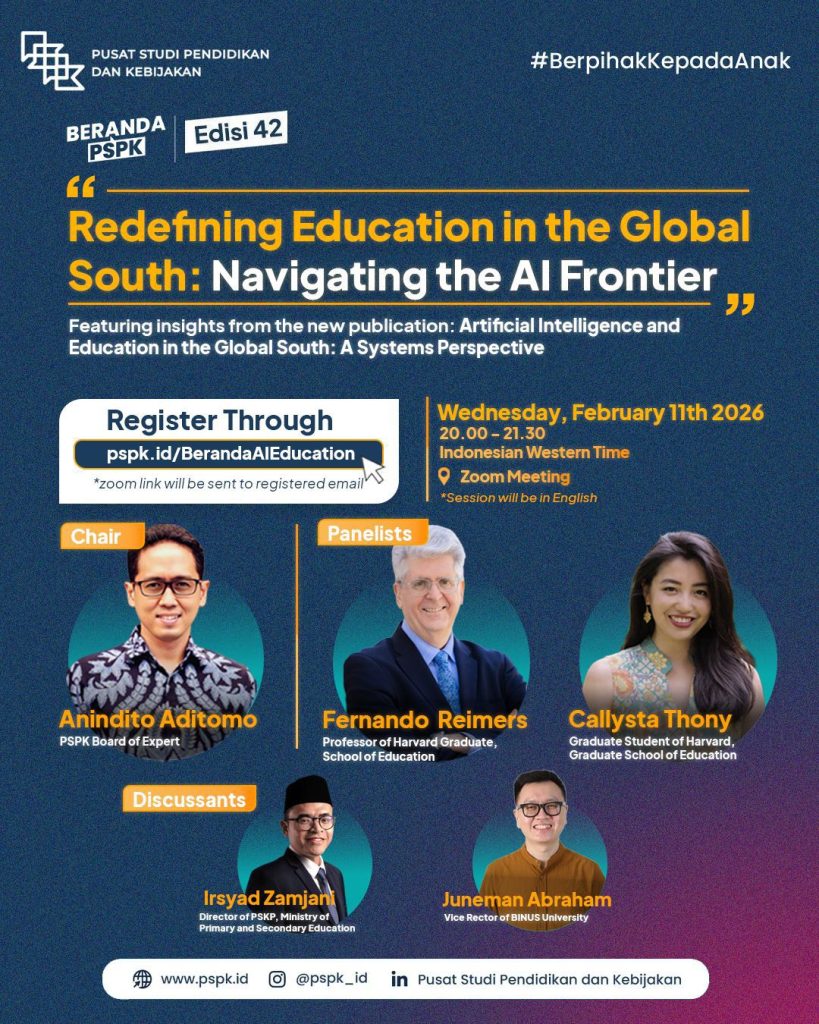
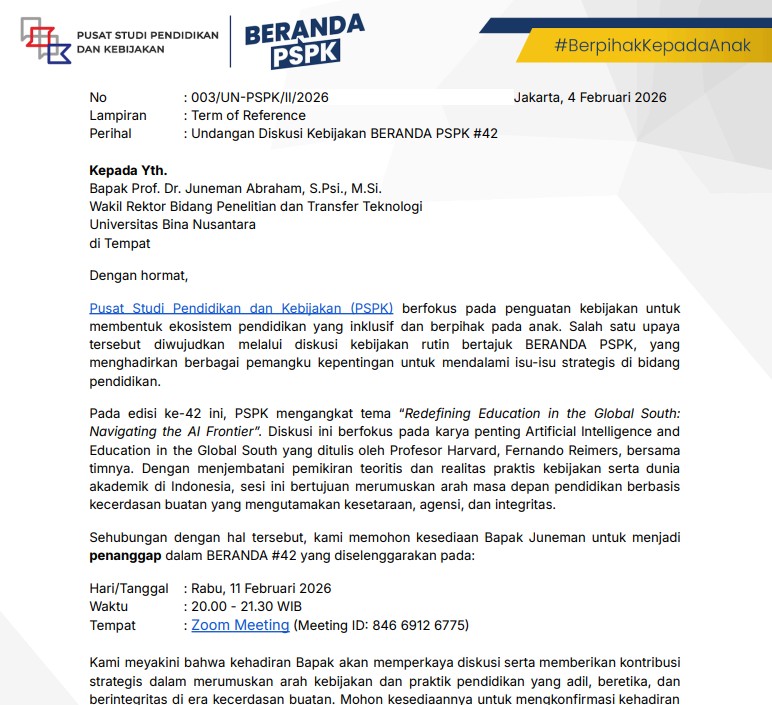
This webinar centers on the seminal work, Artificial Intelligence and Education in the Global
South, authored by a distinguished Harvard Professor, Fernando Reimers and team. By bridging theoretical insights with the practical realities of Indonesian policy and academia, this session aims to chart a course for an AI-integrated educational future that prioritizes equity, agency, and integrity.
Speakers & Panelists
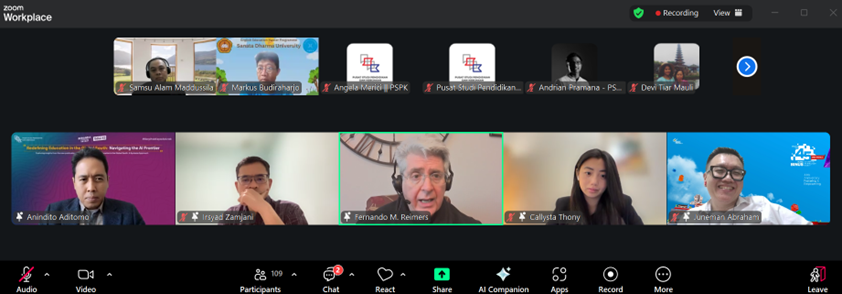
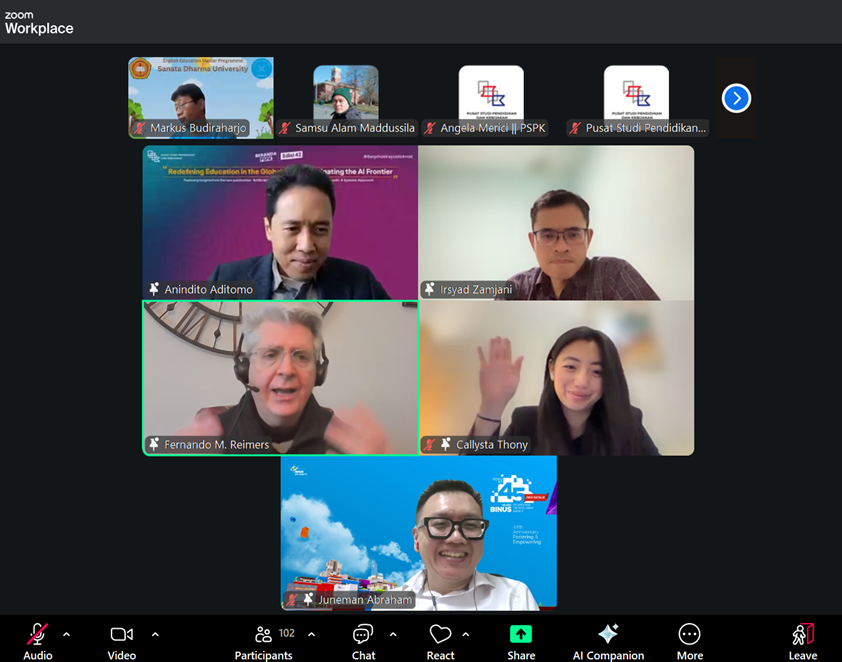
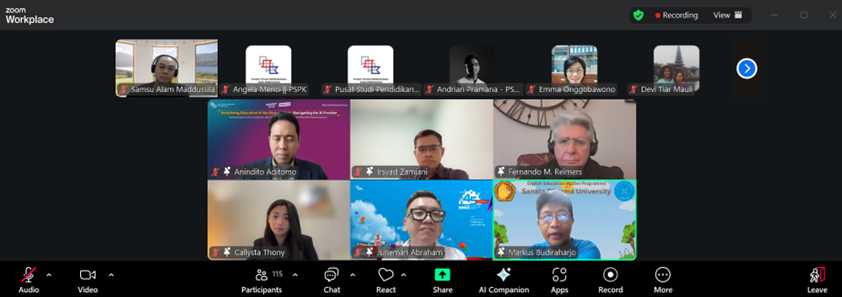
● Fernando Reimers, Professor of Harvard GSE
● Callysta Thony, Graduate Student Harvard GSE
Juneman Abraham’s remarks on this webinar:
Good morning, Good afternoon, Professor Reimers and friends from around the world. I am speaking to you from Jakarta, a city that never sleeps, mostly because we are constantly trying to navigate the future.
I spent my weekend with your book, ‘Artificial Intelligence and Education in the Global South.’ Your ‘Systems Perspective’ is a remarkably clear mirror. But as I looked into it, I saw some deep, unsettling cracks; cracks that reflect the messy, beautiful, and challenging reality of our Indonesian archipelago. Today, I want to show you what happens when your ‘Global Systems’ meet our ‘Local Struggles.’
In Indonesia, we are currently in a national ‘head-to-head’ over Tuition Fees, or UKT (uang kuliah tunggal). Our officials recently called higher education a ‘tertiary luxury’, like a designer handbag rather than a fundamental right.
In this business-driven model, AI risks becoming a ‘cost-cutting’ engine rather than an empowering one. Why pay for empathetic human mentors when you can offer a cheap, automated bot? This creates a tragic paradox: we tell students AI is a ‘leapfrog’ tool, yet the cost of the digital infrastructure is passed down to them through hiked fees. If a student in a remote village is priced out because of the ‘cost of progress,’ then AI isn’t a bridge; it’s a high-tech fence.
This leads to a cultural pathology: the ‘Joki’ or ghostwriting industry. The “Joki” (ghostwriting) industry in Indonesia is not just a technical glitch, but a failure of the Psychological Contract fueled by a “shortcut culture” (In Indonesia, we have a term: ‘Mental Terabas, Mental Jalan Pintas’). When students feel they are ‘buying’ a degree at a premium price, they naturally look for the most efficient way to get the ‘product.’
Our RI-Square (Integrity Risk Index) data shows a crisis of academic honesty. Based on RI-Square (Integrity Risk Index) data, AI often acts as “oxygen” for these practices by serving as a Moral Buffer. This phenomenon triggers Moral Disengagement, where technology masks the human face behind the work, making cheating feel like mere “process optimization” rather than an ethical violation.
Without bold policy intervention, we risk being trapped in a hollow loop of automation. If we don’t change how we evaluate students, i.e. shifting from testing final texts to being ‘Orchestrators’ of the learning process; we are simply paying machines to lie to other machines, while the soul of education disappears. The solution is not just better AI detectors, but by strengthening human connections through Formative Assessment. We must shift the focus from the final output to the learning process, ensuring AI empowers student agency rather than dissolving intellectual integrity within a transactional system.
Finally, we must talk about the humans. Professor, you envision teachers as ‘Orchestrators.’ But in Indonesia, many lecturers earn below a living wage. An exhausted, underpaid faculty cannot safeguard a system, no matter how advanced the AI is.
Furthermore, our agencies, like BRIN, focus heavily on top-down research. We have a policy vacuum for Citizen Science. If our AI models only reason through Western logic, they will erase our local wisdom of ‘Gotong Royong’ (communal help). We don’t just want AI that speaks Indonesian; we want AI that thinks through our indigenous logic and empowers the farmer, not just the bureaucrat.
Professor Reimers, I leave you with these provocations for your session:
- On policy – How do we act on integrity risks like RI-Square without fear of hurting graduation statistics?
- On justice – How do we stop AI from becoming an extra burden for students from low-income families, making the digital divide even wider than before?
- On sovereignty – How can your framework help us pressure agencies to treat science as a ‘democracy’, i.e. validating the knowledge of ordinary citizens?
Let us ensure that AI in the Global South leads to the professionalization of our people, not their replacement. Thank you.